Bedrock Data, the platform provider for data security and AI governance, today announced that Agent DLP™, its runtime data loss prevention for AI agents, now infers a user’s intent (the business purpose behind the task) and evaluates the agent’s behavior (the sum of its actions across every tool and LLM call) against that intent and the organization’s policy. By weighing both intent and behavior, Agent DLP lets employees keep working with AI agents while sensitive data stays protected. Agent DLP adds support for off-the-shelf AI tools employees and developers use, including AI assistants such as Claude, Claude Cowork and ChatGPT; coding agents such as Claude Code, Codex and Snowflake Cortex Code; data platform agents such as Snowflake Cortex; and AI gateways such as Bifrost. It is generally available today and will be demonstrated at AWS re:Invent 2026 in Las Vegas, November 30 to December 4.
This press release features multimedia. View the full release here: https://www.businesswire.com/news/home/20261123623377/en/
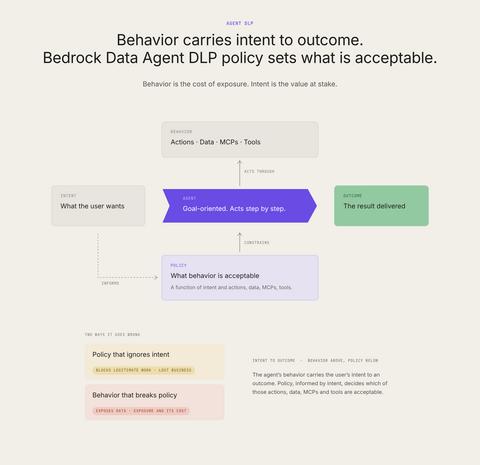
As an AI agent works toward a user’s goal, Bedrock Data Agent DLP checks its behavior (the actions it takes, the data it touches and the MCP tools it calls) against organizational policy. Authorized work keeps moving and sensitive data exposure is stopped.
According to Forrester, “Governing AI agents starts with controlling intent and authority, not models or tools. Agentic systems interpret goals, make decisions, and act across systems. Governance must therefore define and monitor whom an agent is allowed to act for, under what authority, and within which bounds.”1 Enterprises are putting agents to work across development, customer support and business processes. In EY’s 2026 survey of senior AI executives at U.S. companies with at least $1 billion in revenue, 85% of executives whose organizations use agentic AI said some of their systems execute actions without real-time human involvement.
Agents are goal-oriented and take whatever actions reach the outcome a user asks for, even risky ones, such as changing security settings to get around a block, saving sensitive files to unsecured locations or sending data to unapproved MCP servers. Identity and access controls decide what an agent can access, not what it does with that access.
“Most enterprises have more agents than they think, and like most new technology, developers got there first,” said Bruno Kurtic, CEO and co-founder of Bedrock Data. “Tools like Claude Code Enterprise put agents in the hands of developers who already have broad access to production systems, credentials and customer data. In our early deployments, the riskiest activity often matched no existing policy at all. Seeing what those agents do tells a security team which policies to write first and which data to clean up, so they can enforce where the risk is real and let the rest of the work run.”
Intent, Behavior and Policy Define How Agent DLP Governs AI Agents
Agent DLP looks at what an agent does: the actions it takes, the data it touches, and the MCP servers and tools it calls. It evaluates this behavior alongside the inferred intent, the business purpose the user set out to accomplish. Authorized work continues uninterrupted. When that behavior puts sensitive data at risk, Agent DLP responds according to policy by alerting the security team, masking the sensitive data or blocking the action.
“CISOs don’t want a tool that blocks authorized work, but they also don’t want policies that miss exposure,” said Sanjay Srivastava, VP of Product at Bedrock Data. “Agent DLP reads why the user asked, sees what the agent does with the data and applies the organization’s policy to both, so authorized work proceeds and exposure is stopped.”
Agent DLP judges each action in light of the user’s intent and the actions that came before it, then reviews the session as a whole, so it catches individually allowed actions that add up to exposure, with minimal latency at runtime. It plugs in wherever agents act: as a hook in tools such as Claude Code and Codex, at gateways such as LiteLLM and Bifrost, and in agent runtimes such as Amazon Bedrock AgentCore and NVIDIA OpenShell. Agent DLP also inventories the agents in use and the tools, MCP servers and identities each relies on, and keeps a full audit trail of every action for regulatory review.
Security teams write policies in natural language to describe what agents may do. Agent DLP enforces them against the same classifications Bedrock Data uses for data security posture management (DSPM), covering structured and unstructured sensitive data across on-premises, SaaS and infrastructure platforms, so a policy means the same thing for stored data and for data an agent is using. Sensitive data includes regulated and business-critical categories such as PII, PHI, payment card data, credentials and secrets, financial records, material nonpublic information (MNPI) and proprietary source code or IP, plus any category a customer defines.
“Home service pros trust us to run their businesses, and that trust extends to the homeowners they serve,” said Nate Burford, Housecall Pro SVP and CIO. “As we put AI to work across our teams, Bedrock Data’s Agent DLP gives us visibility into how our agents handle customer data, so we can move fast and keep it governed.”
For example, Agent DLP can block an agent from downloading regulated PII or sending it to Slack, email or another MCP server. It can also detect a toxic data combination, such as a name, a date of birth and a medical diagnosis, whether it appears in one action or builds up across a session, and mask one element so the full combination never appears in plain view.
A global investor in enterprise technology and a leading advocate for agentic AI uses Agent DLP to govern how agents work with sensitive data across its own teams. According to the CISO at this global private equity firm, “We put agentic AI to work in our own business, not just in what we invest in, and our people use agents every day on sensitive information. Agent DLP understands what each agent is doing with our data and why, so our teams can move fast while meeting the regulatory and contractual obligations we hold ourselves to.”
Availability
Agent DLP is generally available today as a standalone product and as part of the Bedrock Data ArgusAI platform. It works with Claude, Claude Code, Claude Cowork, ChatGPT, Codex, Snowflake Cortex, Snowflake Cortex Code, Bifrost, LiteLLM, Amazon Bedrock AgentCore and NVIDIA OpenShell, with models that run through Amazon Bedrock, and with other AI tools, gateways and agent runtimes. Customers connect Agent DLP to each tool, gateway or runtime they want to govern.
1 Katie Linford, Jessie Johnson, Steven Casey, Audrey Bond, Arianne Burnette. (June 8, 2026) Model Overview Report, The Forrester B2B AI Agent Lifecycle Framework. Forrester. https://www.forrester.com/report/the-forrester-b2b-ai-agent-lifecycle-framework/RES196563
Additional Resources
- Read the Bedrock Data blog to learn more about Agent DLP
- Request a Bedrock Data platform demo
- Follow Bedrock Data on LinkedIn, X and Bluesky
About Bedrock Data
Bedrock Data is a data security and AI governance platform built on an enterprise knowledge graph of the company’s data: what it is, where it lives, where it came from, who can access it and how it is used. Bedrock Data builds and maintains that graph, its patented Metadata Lake, by discovering and classifying data in place across cloud, SaaS, AI and on-premises environments at petabyte scale, without moving data outside customer boundaries. Its open, API-first design delivers those facts to the tools already in the enterprise stack and makes them the basis for policy enforcement, AI governance and automated remediation. Security, data, infrastructure and AI leaders in technology, finance, healthcare and biotech rely on Bedrock Data to secure their data and accelerate AI without increasing risk. Learn more at bedrockdata.ai.
View source version on businesswire.com: https://www.businesswire.com/news/home/20261123623377/en/
Media gallery