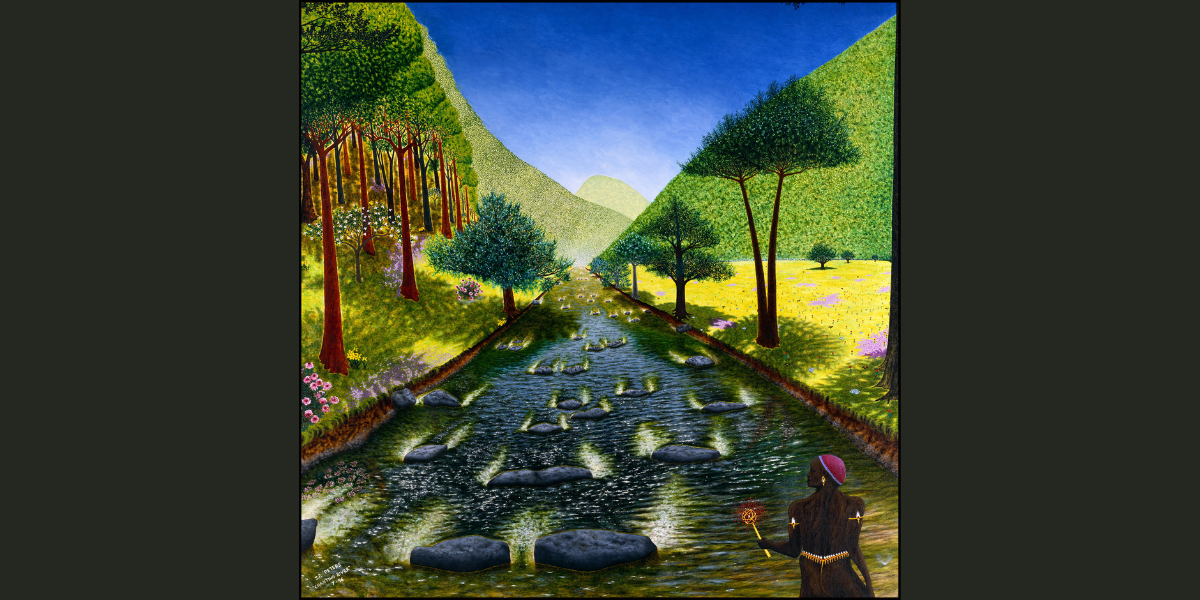
ORLANDO, FL, UNITED STATES, May 27, 2026 /EINPresswire.com/ — While the inspiration for almost all paintings comes through the eyes, “Chanting River” arrived through the rolling thunder and the sound of a roaring river. But mostly, it came through a voice that was nowhere and somehow everywhere.
In this work by John Francis Peters, sight becomes the final step in a journey that began with listening. It’s a path that calls viewers toward a deeper experience of nature and, through that experience, a renewed sense of responsibility to protect it.
The inspiration behind “Chanting River”
The story of “Chanting River” has the texture of myth, yet remains grounded in real stone and water. A thunderstorm rolled into the West Virginia valley where Peters stayed in a stone cabin nestled along a small river surrounded by thick forest.
“Each passing minute, the peacefulness of the woods was charged with electric intensity,” Peters remembers. “Powerful thunder echoed, and the river began to roar, creating a wondrous rolling of sounds in the cabin.”
With the room thrumming as the river braided into thunder, another layer slipped into the soundscape: the sound of a human chant.
“Questioning the voice I heard, I opened the cabin’s sliding door,” Peters says. “The roaring of the river mixed with the intense activity of the storm, but the chanting stopped. I closed the door, and the chanting began again. It was like turning a radio on and off.”
It was as if the living earth invited a listener to dial in to a frequency perpetually playing beneath ordinary awareness. Peters reached for a framework equal to the experience. “Immediately, I recalled Carl Jung, the renowned psychiatrist. My experience felt extremely similar to the ones he had experienced in his stone cabin, as he studied the mind’s collective unconsciousness.”
The painting’s psychological depth springs from the threshold where Jung believed the border between the inner image and the outer world thins, where the collective human and more-than-human speak in symbols and sound.
“A sound heard produces an image in the mind,” explains Peters. “I saw that chanting man in my imagination. After four years, the image told me to create a painting. ‘Chanting River’ is what I created from my experience.”
What “Chanting River” says to viewers today
Four years is a long tether between sound and image. That duration suggests devotion.
The resulting painting returns that devotion to its audience, inviting viewers not only to look, but to listen at the banks of their own river and hear what the natural world is saying.
For those who heed it, the chant becomes a compass that points toward woods and shorelines, twilight horizons and quiet coves. The work implies that such encounters are necessary gateways to presence and care.
At the heart of “Chanting River” is a radical proposition. It says that what is truly experienced is loved, and what is loved is protected. The painting’s chant is, therefore, a summons to stewardship. Environmental responsibility begins not with abstraction but with intimacy. It involves listening closely enough to recognize that a storm and a river possess a voice, and that voice deserves attention.
The piece also models creative attentiveness. What other frequencies persist just below the threshold of routine hearing? What images wait inside the sounds of distant surf, wind threading a stand of pines, or rain tapping code on a windowpane?
Peter’s practice suggests that art is a bridge between the senses and that nature is both a studio and a collaborator. Those who spend time with his other works may find themselves newly attuned, more curious, and more willing to step outside to meet the living world halfway.
“Chanting River” offers a quiet yet insistent directive without ever raising its voice. Viewers often leave imagining the figure that Peters first heard. They feel the storm’s electricity at the edges of memory and sense the river’s ongoing song. Windows open. Shoes find trails. Skies become paintings. Rivers are heard before they are seen.
When the world speaks through thunder, water, and the chorus of all living things, the painting suggests an answer of attentive presence and gratitude. The chant continues, rolling through woods and humming through canvas, and those who listen join the chorus.
Lara Rosales
OtterPR
email us here
Legal Disclaimer:
EIN Presswire provides this news content “as is” without warranty of any kind. We do not accept any responsibility or liability
for the accuracy, content, images, videos, licenses, completeness, legality, or reliability of the information contained in this
article. If you have any complaints or copyright issues related to this article, kindly contact the author above.

Media gallery