
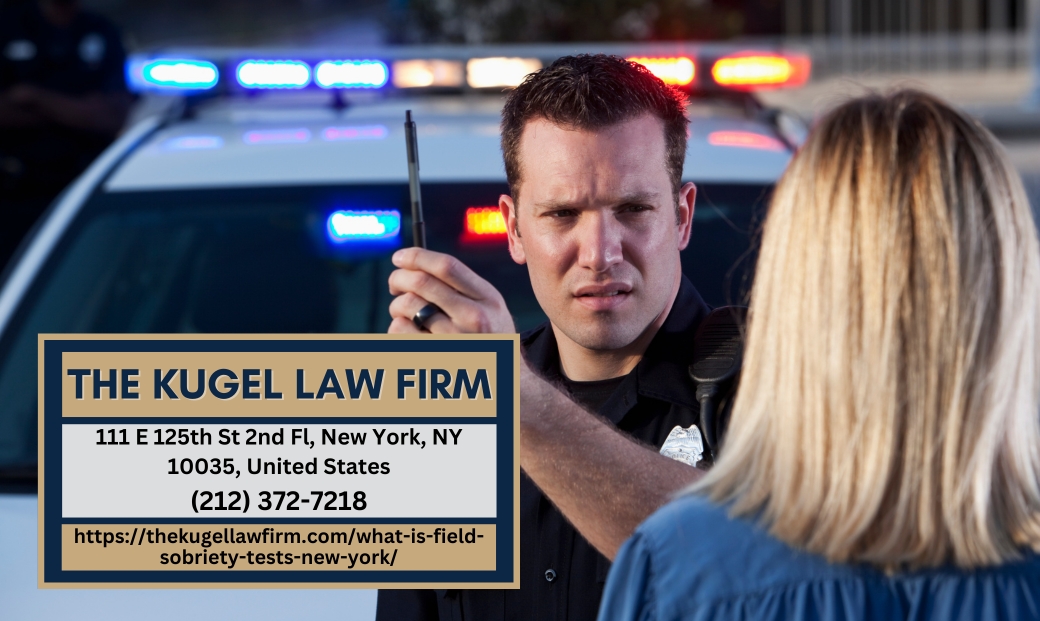
NEW YORK, NY – Drivers stopped on suspicion of impaired driving in New York may be asked to perform physical and cognitive exercises that officers use to assess intoxication, yet these tests are not required by law and their results can be challenged on multiple grounds in court. Manhattan DWI defense attorney Rachel Kugel of The Kugel Law Firm (https://thekugellawfirm.com/what-is-field-sobriety-tests-new-york/) is explaining how field sobriety tests work in DWI cases and what options drivers in Manhattan and New York City have when asked to submit to them.
According to Manhattan DWI defense attorney Rachel Kugel, the National Highway Traffic Safety Administration developed three standardized field sobriety tests used by law enforcement across the country: the Horizontal Gaze Nystagmus test, which tracks involuntary eye jerking that becomes more pronounced with alcohol consumption; the Walk-and-Turn test, a divided attention exercise requiring nine heel-to-toe steps along a straight line; and the One-Leg Stand test, which requires standing on one foot for 30 seconds while counting aloud. Officers look for specific clues during each test, and the number of clues observed helps them decide whether to make an arrest. “These tests are designed for ideal conditions that rarely exist during a roadside stop in New York,” Kugel explains. “Uneven pavement, poor lighting, glare from oncoming headlights, and adverse weather conditions can all compromise the accuracy of the results.”
Manhattan DWI defense attorney Rachel Kugel notes that unlike post-arrest chemical tests governed by VTL Section 1194(2), standardized field sobriety tests are generally voluntary in New York. There is no statutory penalty for refusing to perform them. However, prosecutors may attempt to introduce a refusal at trial as evidence of consciousness of guilt, and New York courts have allowed this inference in DWI cases. The situation differs significantly for chemical tests, where New York’s implied consent law triggers a mandatory one-year license revocation and a $500 civil penalty through the DMV for refusal, regardless of whether the driver is ultimately convicted of DWI.
Attorney Kugel observes that field sobriety test results serve two purposes in a New York DWI case. First, they help officers establish probable cause for an arrest. Second, they can be introduced as evidence at trial to support the prosecution’s claim that the driver was impaired. Under VTL Section 1192(3), a common law DWI conviction is possible based solely on observed impairment without any BAC measurement, which makes field sobriety test performance especially significant when no chemical test was administered. “When the prosecution’s case relies on officer observations rather than a BAC reading, the reliability of these tests becomes the central issue at trial,” she adds.
The Kugel Law Firm points out that many factors unrelated to alcohol consumption can cause poor performance on field sobriety tests. Inner ear disorders, vertigo, back injuries, knee problems, and neurological conditions can all affect balance and coordination. Eye conditions such as strabismus, amblyopia, or prior eye surgery can produce nystagmus that has nothing to do with alcohol. Certain medications, including antihistamines, anti-seizure drugs, and some antidepressants, may also impair coordination or cause involuntary eye movement. Even simple nervousness during a roadside stop in Manhattan can cause shaking, difficulty concentrating, and impaired coordination that an officer may interpret as signs of impairment.
Kugel advises that the most effective defense challenges typically focus on whether officers followed NHTSA protocols during test administration and scoring. The administration’s own training materials state that standardized field sobriety tests are valid only when conducted according to prescribed procedures. If an officer moved the stimulus too quickly during the HGN test or failed to ensure the driver understood the Walk-and-Turn instructions before beginning, the results may be unreliable. Video evidence from body cameras, dashcam recordings, and nearby surveillance cameras can reveal whether the driver actually exhibited the clues the officer claimed to observe. “In some cases, video evidence has contradicted officer testimony entirely,” she notes. “Footage showing a driver performing the tests without difficulty is among the strongest evidence a defense attorney can present in New York City.”
In Manhattan and Harlem, drivers arrested for DWI may be brought to the local NYPD precinct for further processing. The 25th, 28th, and 32nd Precincts cover different sections of the neighborhood, and the specific precinct depends on where the stop occurred. NYPD procedures differ from those elsewhere in New York, with field sobriety tests frequently administered at the precinct rather than on the roadside, which introduces a separate set of environmental conditions and potential procedural issues. At the precinct, drivers may also be asked to submit to a chemical test under VTL Section 1194, which carries different legal consequences than a field sobriety test.
“Regardless of whether a field sobriety test was taken, the most important step after a DWI arrest is to contact an attorney as soon as possible,” Kugel advises. An attorney can review the circumstances of the stop, evaluate the evidence, and begin building a defense strategy. Acting quickly is particularly important because drivers may face a DMV hearing in addition to the criminal case, and there are time-sensitive deadlines involved in preserving the right to challenge a license suspension in New York.
For those who have been arrested after a field sobriety test or believe the test was administered improperly in Manhattan or the surrounding areas of New York City, contacting a DWI defense attorney promptly may help protect rights in both the criminal case and any DMV proceedings.
About The Kugel Law Firm:
The Kugel Law Firm is a Manhattan-based law firm dedicated exclusively to DWI and DUI defense. Led by attorney Rachel Kugel, the firm handles cases at the New York County Criminal Court at 100 Centre Street and throughout New York City, including Manhattan, Harlem, the Bronx, Brooklyn, and Queens. For consultations, call (212) 372-7218.
Embeds:
Youtube Video: https://www.youtube.com/watch?v=_EnX3gdsqfs
GMB: https://www.google.com/maps?cid=17189431107850367088
Email and website
Email: admin@thekugellawfirm.com
Website: https://thekugellawfirm.com/new-york-dwi-lawyer/
Media Contact
Company Name: The Kugel Law Firm
Contact Person: Rachel Kugel
Email: Send Email
Phone: (212) 372-7218
Address:111 E 125th St 2nd Fl
City: New York
State: New York 10035
Country: United States
Website: https://thekugellawfirm.com/new-york-dwi-lawyer/
Press Release Distributed by ABNewswire.com
To view the original version on ABNewswire visit: Manhattan DWI Defense Attorney Rachel Kugel Explains Field Sobriety Tests and Legal Rights in New York


