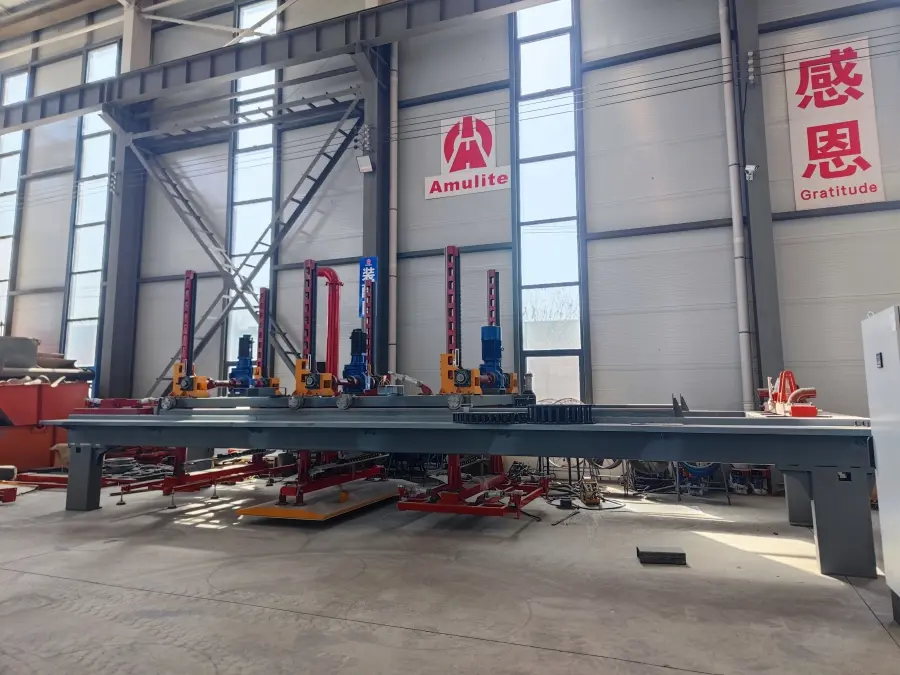
SHIJIAZHUANG, HEBEI, CHINA, June 25, 2026 /EINPresswire.com/ — As global infrastructure projects increasingly demand durable, cost-effective, and sustainable building materials, fiber cement and calcium silicate boards have become central to modern construction specifications. These materials offer exceptional fire resistance, moisture durability, and structural integrity, making them ideal for high-density residential developments, commercial hubs, and industrial facilities worldwide. Consequently, international procurement teams and engineering firms face the critical task of sourcing machinery that can deliver consistent product quality at scale. Selecting a reliable China Fiber Cement Board Machine Manufacturer has emerged as a strategic decision for enterprises looking to establish high-capacity, automated manufacturing lines that align with strict international compliance frameworks.
2
Understanding the manufacturing capability behind these building materials requires a look at the comprehensive engineering ecosystem provided by industry participants. China Amulite Group operates as a major industrial manufacturing group, integrating both advanced machinery fabrication and finished building materials production. The group’s machinery manufacturing division specializes in designing and engineering fully integrated production lines, including Fiber Cement Board and Calcium Silicate Board Production Lines, Cement Corrugated Roof Panels Production Lines, and EPS Sandwich Cement Wall Panels Production Lines. Additionally, their portfolio encompasses Hollow Core Cement Wall Panels Production Lines, MGO Board Production Lines, Calcium Sulfate Board Production Lines, and complete Paper-Face Gypsum Board lines. This dual expertise as both a machinery builder and a material producer allows the group to optimize equipment based on real-world operational insights. On the materials side, the organization manufactures mineral fiber, fiberglass, and rock wool acoustic ceiling tiles, alongside suspending grid systems and PVC gypsum ceiling boards, serving a global clientele across diverse architectural and industrial applications.
When evaluating a machinery manufacturing partner for long-term infrastructure supply chains, technical documentation, material formulation expertise, and engineering precision serve as the foundational benchmarks for selection.
Automated Batching and Raw Material Precision
The structural reliability of a finished fiber cement board depends heavily on the precision of the initial raw material batching process. Modern infrastructure applications require exact ratios of cement, silica sand, cellulose fibers, and specialized additives to achieve the necessary tensile strength and density. An expert manufacturer must design automated dosing and weighing systems that minimize human error and material variance.
Advanced production lines utilize sophisticated PLC (Programmable Logic Controller) systems to manage the distribution of raw ingredients. The integration of high-shear mixers ensures that cellulose fibers are thoroughly defibrated and uniformly distributed throughout the cementitious slurry. Without uniform fiber distribution, the microstructural integrity of the board is compromised, leading to structural weak points, premature cracking, or warping under environmental stress. Therefore, evaluating the engineering design of the slurry preparation system is a primary step during technical audits.
Advanced Forming Technologies and Density Control
The core of any fiber cement board production line rests upon its forming technology, typically utilizing either the Hatschek process or flow-on extrusion systems. The choice of forming technology directly dictates the thickness variation, density distribution, and layering precision of the manufactured boards. Engineering teams must inspect how a machinery supplier manages the dewatering and layering processes.
In high-speed production environments, maintaining a consistent moisture-to-solid ratio during the forming stage is vital. Precise vacuum dewatering systems must be calibrated to remove excess water systematically as the laminate layers build up on the making roll. Furthermore, for high-density applications such as exterior building facades or heavy-duty industrial flooring, the production line must integrate a high-capacity hydraulic post-pressing system. This press compresses the wet boards under immense pressure to achieve the exact density specifications required by international building codes, enhancing the material’s resistance to freeze-thaw cycles and mechanical impacts.
Autoclaving and Curing Infrastructure
Thermal processing determines the long-term chemical stability of cement-based panels. The curing phase typically involves low-pressure steam pre-curing followed by high-pressure, high-temperature autoclaving. Saturated steam within the autoclave environment facilitates a chemical reaction between the calcium hydroxide from the cement and the crystalline silica sand, forming a stable crystalline structure known as tobermorite.
An experienced machinery supplier must deliver autoclaves and steam distribution networks that ensure uniform temperature and pressure zoning throughout the entire chamber. Inconsistent thermal distribution during the autoclaving cycle results in uneven curing, leaving some boards brittle or prone to moisture expansion. Sourcing equipment with robust thermal insulation, automated pressure-release valves, and precise cycle logging software is critical to preventing product rejection during quality control phases.
Downstream Automation, Calibration, and Surface Treatment
The utility of a manufacturing line extends beyond the curing oven to the final calibration and finishing stages. Finished fiber cement boards intended for global infrastructure projects require precise dimensional tolerances. Automated trimming, multi-blade sawing, and sanding systems must operate with minimal mechanical tolerance to ensure squareness and edge profile accuracy.
Furthermore, modern architectural specifications frequently require pre-finished or coated panels. Production lines that offer integrated UV-painted processing lines and automated surface treatment stations allow operators to produce high-value decorative cladding in a single continuous workflow. Sourcing these components from a single engineering group reduces integration conflicts between different mechanical sections, ensuring smooth material handling, automated stacking, and palletizing processes that minimize physical damage prior to shipping.
Compliance, Technical Documentation, and Cross-Platform Expertise
Global infrastructure developments operate under rigid regulatory frameworks, demanding that all production machinery complies with strict occupational safety and environmental standards. Machinery destinados for export must meet relevant international engineering directives, including structural safety certifications, standardized electrical layouts, and efficient dust extraction frameworks to maintain factory air quality.
Beyond mechanical hardware, long-term operational success depends on the depth of technical documentation, formulation support, and commissioning services provided by the manufacturer. Industrial operators require exhaustive equipment schematics, preventative maintenance schedules, and comprehensive operator training programs. An equipment partner that understands the nuanced chemical reactions of alternative raw materials can assist operators in optimizing formulas based on locally available sand, cement grades, and fiber sources, thereby driving down localized production costs while maintaining global performance metrics.
Aligning factory expansion with a manufacturing partner that understands both the mechanical engineering of machinery and the physical properties of finished cementitious products creates a distinct operational advantage. By verifying automated batching accuracy, mechanical forming capabilities, thermal curing uniformity, and integrated downstream processing, international purchasing entities can secure production lines capable of meeting rigorous project timelines. Enterprises focused on establishing robust, automated production facilities for fiber cement board and related industrial building materials can explore comprehensive technical specifications and operational case studies by visiting the corporate resource archive at https://www.amulitegroup.com/.
China Amulite Group
China Amulite Group
email us here
Legal Disclaimer:
EIN Presswire provides this news content “as is” without warranty of any kind. We do not accept any responsibility or liability
for the accuracy, content, images, videos, licenses, completeness, legality, or reliability of the information contained in this
article. If you have any complaints or copyright issues related to this article, kindly contact the author above.

Media gallery