SHANGHAI, SHANGHAI, CHINA, August 25, 2026 /EINPresswire.com/ — Heavy industries rely heavily on fluid machinery to maintain continuous operations across power generation, chemical processing, and municipal water networks. Severe mechanical stress often challenges these systems when handling high-pressure liquid distribution. Unexpected vibration can instantly disrupt plant productivity, escalate energy consumption, and cause severe capital damage. Plant operators consistently search for reliable partners to eliminate these hidden mechanical failures before they impact the bottom line. Recognizing this critical market need, an experienced technical leader has emerged as a Professional Pump Balancing Machine Provider that delivers specialized hardware capable of stabilizing heavy-duty rotating assets. By prioritizing mathematical precision over standard assembly line production, industrial manufacturers safeguard their long-term operational integrity. Therefore, understanding the underlying physics of rotor unbalance becomes the first step toward achieving total plant reliability.
The Hidden Penalty of Dynamic Deflection in High-Pressure Fluid Machinery
Industrial fluid machinery frequently operates under intense hydraulic pressure, generating significant mechanical loads on internal components. Specifically, multistage centrifugal pumps require several impellers arranged in series along a single shaft to build up operational pressure. This multi-impeller setup increases the physical vulnerability of the rotating assembly during high-speed operation. Even minor mass distribution variations along the shaft create massive centrifugal forces. Consequently, these forces induce dynamic deflection, a condition where the shaft physically bends away from its true rotational center. Standard balancing equipment often fails to detect these complex deformations because they only evaluate the rotor at rest or at low velocities. Furthermore, dynamic deflection generates continuous cyclic stress that concentrates directly on critical bearing housings and mechanical seals, accelerating wear and leading to structural breakdown.
Industrial operators cannot resolve these multi-plane unbalance issues by utilizing basic, single-plane calibration tools. Instead, heavy industries require an advanced engineering approach that treats the entire rotor assembly as a complex, flexible system. When high-pressure pumps operate in large-scale municipal water conservancy projects or mining applications, fluid turbulence further compounds the mechanical strain. For this reason, static calibration proves insufficient for predicting how a multi-impeller system behaves under full operational velocity. By analyzing the dynamic behavior of the rotor under simulated load conditions, engineers can isolate specific vibration signatures. This analytical precision allows operators to optimize hydraulic efficiency, eliminate structural resonance, and prevent unexpected maintenance shutdowns.
Engineering the Solution: JP’s Heavy-Duty and Automated Balancing Architecture
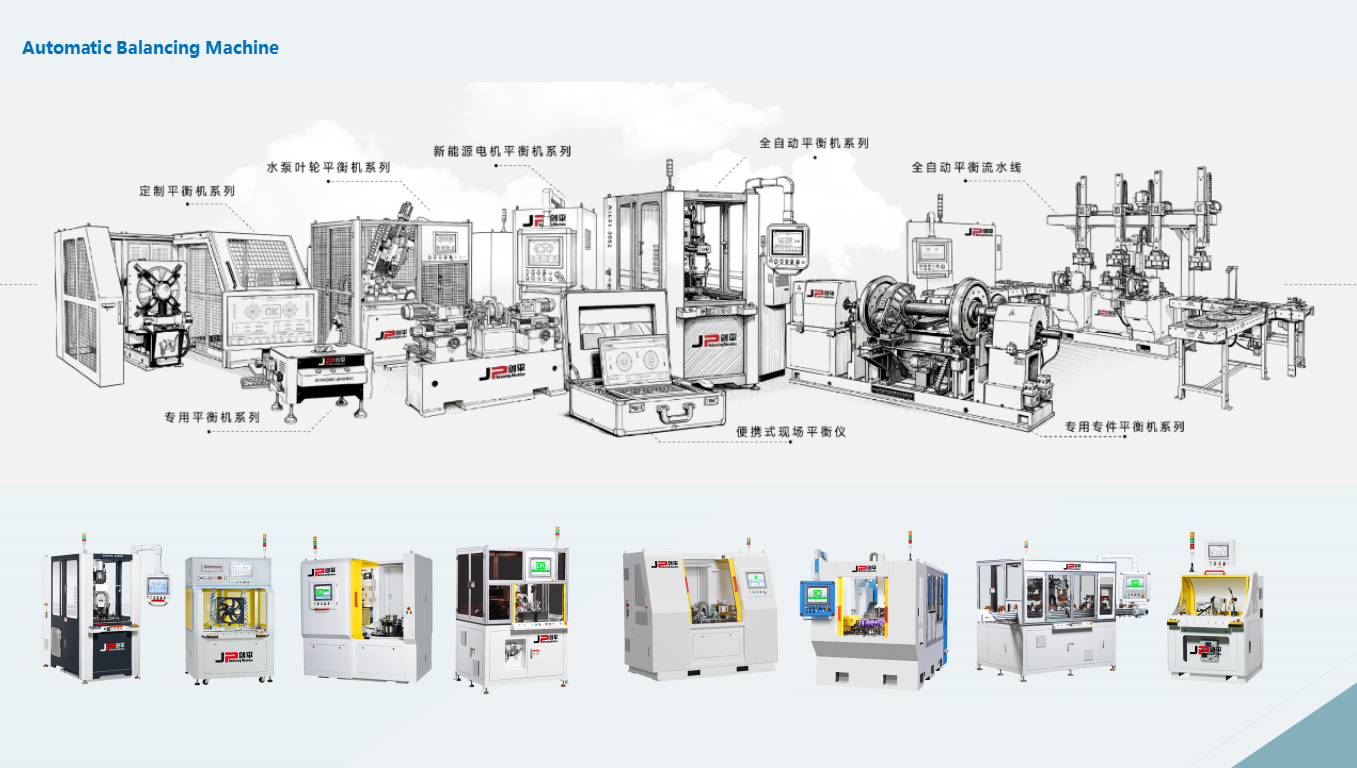
To address these complex fluid engineering challenges, Shanghai Jianping Dynamic Balancing Machine Manufacturing Co., Ltd provides an advanced portfolio of specialized diagnostic machinery. Industrial plants require diverse equipment configurations because every pump impeller and rotor geometry features unique mass characteristics. Instead of offering generic, one-size-fits-all hardware, the manufacturer segmentates its technical catalog into highly targeted machinery types. This precise classification guarantees that each industrial sector receives equipment optimized for its specific structural requirements. By isolating distinct manufacturing demands, facilities can select balancing systems that match their operational workflows without compromising calibration accuracy.
First, specialized water pump impeller balancing machines focus exclusively on disc-shaped industrial components, including single impellers, brake drums, and automotive ventilation fans. These machines frequently utilize customized pneumatic expansion fixtures to achieve rapid loading and unloading during routine calibration cycles. This pneumatic clamping mechanism ensures highly repeatable placement, eliminating variance caused by manual operator adjustments. Engineers configure these systems for single-plane or dual-plane measurement depending on the thickness of the specific impeller profile. As a result, components achieve perfect hydrodynamic balance before undergoing final integration into the pump housing, directly improving baseline fluid efficiency.
Second, the vacuum pump industry requires specialized automation to maintain manufacturing efficiency during high-volume production schedules. To satisfy this market need, the vacuum pump rotor fully automatic balancing machine, such as the A1LZ1-35 fully automatic drilling balancing machine, delivers rapid, automated mass-correction cycles. This dedicated machine targets vacuum pump impellers and specific vacuum rotors rather than heavy-tonnage industrial assets. The system integrates high-precision digital measurement sensors with an onboard pneumatic drilling unit to execute corrections automatically. The internal computing system calculates the exact location and depth of the required weight removal, executing the drilling cycle without manual human intervention. Consequently, this automation eliminates human measurement error and accelerates production output.
Third, heavy industrial operations utilize large rotating assets that exceed standard weight limitations. For these extreme applications, heavy-duty universal joint driven balancing machines provide the ideal solution for large-tonnage rotors, including massive multi-stage pump rotors and large centrifugal fan impellers. Because these heavy workpieces require substantial torque to overcome inertia during testing, standard belt-driven configurations often experience slippage or introduce measurement interference. In contrast, the universal joint coupling provides a positive mechanical connection that delivers smooth power transmission directly to the heavy rotor. This robust drive mechanism ensures absolute safety during high-tonnage rotation while preventing drive-induced residual errors from entering the data stream.
Overcoming the Duality of Massive Initial Unbalance and Micron-Level Re-Testing
Industrial balancing engineers routinely face a difficult paradox when preparing heavy-duty fluid machinery for high-pressure applications. Large multistage rotors often arrive at the testing station with massive initial unbalance due to casting variations and complex multi-component assembly. However, the final operational specifications demand strict, micron-level residual unbalance tolerances to guarantee smooth long-term operation. Resolving this deep technical gap requires a stiff mechanical architecture combined with highly sophisticated electronic signal processing. For this reason, the engineering team at JP (Shanghai Jianping Dynamic Balancing Machine Manufacturing Co., Ltd ) utilizes a rigid pendulum frame design that provides absolute mechanical isolation from background factory floor noise. This heavy structural foundation exhibits minimal vibration damping, ensuring that the physical sensors capture only true unbalance data.
Furthermore, advanced digital measuring units process these raw electrical signals through multi-tier mathematical compensation matrices. These algorithms effectively eliminate cross-talk between separate correction planes along elongated axial shafts, ensuring independent dual-plane precision. The software also applies specialized tooling and fixture compensation to mathematically subtract any geometric eccentricity caused by the physical clamping mechanisms. Additionally, high-speed configurations feature dynamic deflection tracking to monitor flexible rotors in real time. Therefore, the testing instrument maintains excellent linearity across highly volatile frequency spectrums. This integration of rigid hardware and adaptive software allows manufacturing facilities to execute highly repeatable calibration cycles.
Institutional Trust and the Data-Driven Infrastructure of Global Heavy Industry
Establishing long-term operational reliability requires a verifiable foundation of corporate experience and verified engineering standards. Over a 22-year corporate foundation, JP has secured 12 invention patents, 60 utility model patents, and 22 software copyrights. This extensive research background elevates their machinery beyond generic fabrication into a highly repeatable mathematical science. To protect international buyers, the manufacturing facilities maintain strict compliance with global quality frameworks, including TUV ISO 9001:2015 and SGS ISO 14001. Furthermore, the enterprise achieved official CNAS laboratory accreditation, which guarantees international traceability for all calibration records.
Today, more than 15,000 cooperative customers across 100 countries utilize these precision balancing systems to safeguard their heavy industrial operations. Modern automated production facilities also benefit from seamless digital ecosystem integration via real-time Manufacturing Execution System (MES) data uploads. This digital connectivity provides complete documentation for every balanced component, satisfying strict quality control audits. To sustain this high level of field performance, a comprehensive, cloud-managed after-sales service infrastructure delivers automated maintenance tracking and remote diagnostic support worldwide. This proactive data-driven support ensures maximum machine uptime for global heavy industries. For more technical parameters and customized integration options, industrial operators can visit the official corporate gateway at https://www.jp-balancer.com/.
Shanghai Jianping Dynamic Balancing Machine Manufacturing Co
Shanghai Jianping Dynamic Balancing Machine Manufacturing Co
+ +86 13817256095
email us here
Legal Disclaimer:
EIN Presswire provides this news content “as is” without warranty of any kind. We do not accept any responsibility or liability
for the accuracy, content, images, videos, licenses, completeness, legality, or reliability of the information contained in this
article. If you have any complaints or copyright issues related to this article, kindly contact the author above.

Media gallery