The Business Research Company’s Collaborative Robots Global Market Report 2026 – Market Size, Trends, And Forecast 2026-2035
LONDON, GREATER LONDON, UNITED KINGDOM, October 26, 2026 /EINPresswire.com/ — “The collaborative robots sector is poised for remarkable growth as industries worldwide increasingly embrace automation to enhance productivity and efficiency. With technological advancements and rising demand across various manufacturing verticals, this market is set to transform the future of industrial operations. Let’s explore the market size, regional leaders, key drivers, segments, and competitive landscape shaping this dynamic industry.
Projected Value and Market Position of the Collaborative Robots Market
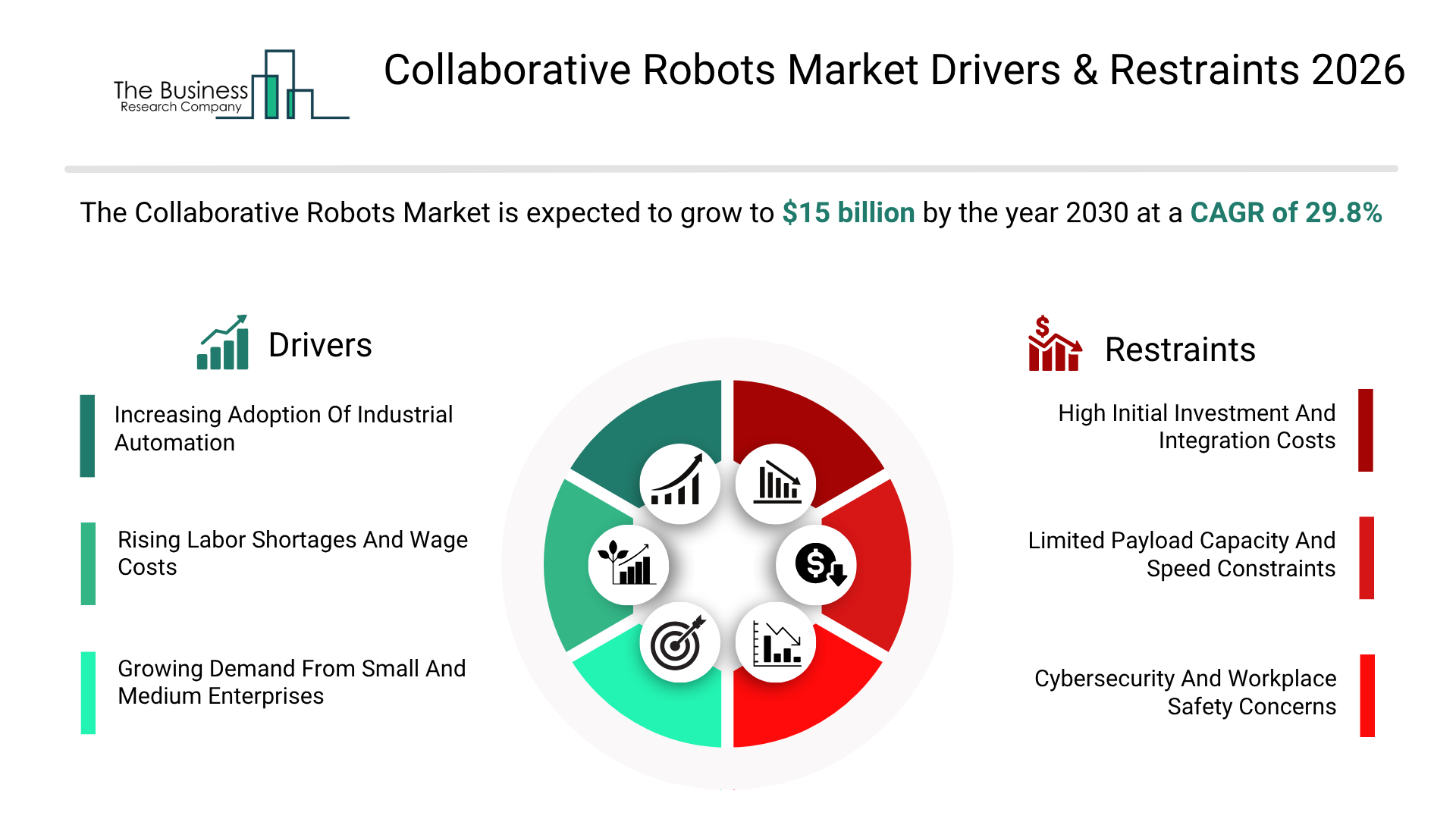
By 2030, the collaborative robots market is expected to surpass $15 billion. In comparison, its broader parent market, Smart Robots, is forecasted to reach around $53 billion by then, with collaborative robots contributing roughly 29% of that total. When viewed within the vast Machinery industry, which is anticipated to grow to $5,280 billion by 2030, collaborative robots will represent close to 0.3% of the overall market value.
Request A Free Sample Of The Collaborative Robots Market Report
https://thebusinessresearchcompany.com/sample_request?id=9449&type=smp&name=Collaborative%20Robots%20Market%20Report%202026&utm_source=EINPresswire&utm_medium=Paid&utm_campaign=Oct_PR
Asia-Pacific to Lead the Collaborative Robots Market by 2030
Asia-Pacific will hold the largest regional share in the collaborative robots market in 2030, valued at $6 billion. Starting from $2 billion in 2025, the region is expected to grow at a compound annual growth rate (CAGR) of 30%. This rapid expansion is driven by widespread industrial automation initiatives, rising usage of flexible robotic solutions among small and medium-sized enterprises (SMEs), and increasing demand for human-robot collaboration particularly in electronics, automotive, and consumer goods production. Additional factors include labor shortages, the rise of smart factories, and rising investments in automation infrastructure across countries like China, Japan, South Korea, and Southeast Asia.
China’s Dominance in the Collaborative Robots Market by Country
China is projected to be the leading country in the collaborative robots market by 2030, with a valuation of $4 billion. It will grow from $1 billion in 2025 at a CAGR of 30%. This growth reflects China’s extensive adoption of robotics within manufacturing hubs, especially for precision assembly and quality inspection. The country’s booming electronics and semiconductor sectors, expansion of domestic robotics manufacturers, and government initiatives promoting smart manufacturing all play significant roles in driving this surge.
Access The Detailed Collaborative Robots Market Report Here
https://thebusinessresearchcompany.com/report/collaborative-robots-global-market-report?utm_source=EINPresswire&utm_medium=Paid&utm_campaign=Oct_PR
Hardware Segment Forecast to Dominate Collaborative Robots Market
In 2030, the hardware segment of the collaborative robots market will be the largest among components, accounting for 65% or $10 billion of the total market. Demand for robotic arms, sensors, controllers, and end-effectors is increasing due to their critical role in industrial applications. The need for greater precision and safety, advancements in actuator and sensor technologies, integration of vision systems, and force-control features are all fueling growth in hardware. Investments aimed at boosting productivity and operational efficiency in manufacturing are further supporting this segment.
Payload and Application Distribution in Collaborative Robots Market
The collaborative robots market is categorized by payload capacities into three groups: up to 5kg, up to 10kg, and over 10kg. Application-wise, the market spans assembly, pick and place, handling, packaging, quality testing, gluing and welding, among other uses, reflecting the broad adoption of cobots across various industrial tasks.
Forecasted Growth Rate for the Collaborative Robots Market
The collaborative robots market is expected to expand at a robust CAGR of 30% leading up to 2030, signaling strong momentum fueled by ongoing technological advancements and rising adoption across sectors.
Industrial Automation Adoption as a Major Growth Driver
One of the key factors propelling the collaborative robots market forward is the rising uptake of industrial automation. Manufacturers are prioritizing automation to boost productivity, increase operational efficiency, and ensure consistent quality. Collaborative robots are becoming vital in smart factories, enabling smoother human-machine interactions and optimizing complex industrial processes. This shift is anticipated to contribute an annual growth rate of about 2.7% to the market.
Labor Shortages and Rising Wage Costs Boosting Market Expansion
Increasing labor shortages and escalating wage expenses are significant forces driving collaborative robot deployment. Industries face challenges in sourcing skilled workers for repetitive or hazardous tasks, prompting greater reliance on cobots to maintain production continuity while managing labor costs effectively. Automation allows human workers to focus on more strategic roles, enhancing overall output and reducing dependence on fluctuating labor markets. This factor is expected to add roughly 2.4% annual growth to the market.
SMEs Driving Demand for Collaborative Robots Through Accessibility
Small and medium enterprises are increasingly turning to collaborative robots as affordable and scalable automation solutions. Their flexibility, ease of programming, and relatively low initial investments make cobots especially appealing for SMEs looking to improve efficiency and product quality without massive infrastructure changes. This trend is forecasted to generate around 2.2% annual growth in the market.
Key Growth Opportunities in Hardware and Software Segments
The collaborative robots market will see its most significant growth opportunities in both hardware and software segments, collectively expected to exceed $11 billion by 2030. Growth is fueled by deployment in precision manufacturing, demand for real-time motion control, interconnected robotic workflows in smart factories, and advancements in human-robot interaction. Continued innovation in safety, scalability, and predictive maintenance capabilities is also driving this expansion, reflecting a broader trend toward intelligent and flexible automation.
Hardware and Software Market Expansion Projections
Between 2025 and 2030, the hardware market is projected to grow by $7 billion, while the software segment is expected to increase by $4 billion. Leading industrial automation providers and robotics specialists are focusing on AI-enabled control platforms, advanced safety features, and enhanced human-robot collaboration systems to strengthen their market position and support evolving manufacturing needs.
Market Leadership by Teradyne and Other Key Players
Teradyne’s robotics automation division, particularly Universal Robots A/S, led global sales in 2025 with a 5% market share. Their portfolio includes collaborative robotic arms, intelligent automation solutions, and software platforms designed to improve flexibility and human-robot interaction in industrial settings.
Major Companies Shaping the Collaborative Robots Industry
The collaborative robots market features several prominent players such as Teradyne (Universal Robots A/S), FANUC Corporation, Yaskawa Electric Corporation, KUKA AG, ABB Group, TECHMAN ROBOT INC., Kawasaki Heavy Industries Ltd., Denso Corporation, Omron Corporation, and Doosan Robotics Inc. These companies maintain strong market shares through diversified products, innovation, and extensive global distribution networks.
Market Fragmentation and Competitive Landscape
The market is moderately fragmented, with the top 10 players holding approximately 17% of total revenue in 2025. This reflects considerable entry barriers due to the technical expertise required, stringent safety standards, and complex system integration needs. Leading companies focus on flexible automation, AI-driven control systems, and ensuring compliance with industrial safety protocols to capture growth opportunities and meet customer demands.
Key Suppliers of Raw Materials for Collaborative Robots
Major raw material suppliers that underpin the collaborative robots ecosystem include FANUC Corporation, Yaskawa Electric Corporation, ABB Ltd., KUKA AG, Universal Robots A/S, Kawasaki Heavy Industries Limited, Mitsubishi Electric Corporation, Denso Corporation, Epson Robots, Nachi-Fujikoshi Corporation, Comau S.p.A., and several others specializing in robotics components and automation solutions.
Prominent Wholesalers and Distributors Supporting Market Reach
Wholesalers and distributors such as Arrow Electronics Inc., Avnet Inc., Ingram Micro Inc., Tech Data Corporation, Digi-Key Electronics, Mouser Electronics Inc., RS Components Limited, and others play vital roles in delivering collaborative robots and components to manufacturers and end users worldwide.
Leading End Users Driving Demand for Collaborative Robots
Major end users include top global companies like Toyota Motor Corporation, Tesla Inc., BMW Group, Volkswagen AG, Ford Motor Company, General Motors Company, Mercedes-Benz Group AG, Hyundai Motor Company, Honda Motor Co. Ltd., Nissan Motor Co. Ltd., Stellantis N.V., BYD Company Limited, Foxconn Technology Group, Apple Inc., Samsung Electronics Co. Ltd., LG Electronics Inc., Sony Group Corporation, Flex Ltd., Jabil Inc., Caterpillar Inc., Deere & Company, Boeing Company, Airbus SE, Procter & Gamble Company, and Unilever PLC.
Emerging Competitive Trends Transforming the Collaborative Robots Market
High-payload six-axis collaborative robots are revolutionizing productivity and safety in smart factories. For example, Delta Electronics introduced its D-Bot series in India in February 2025, featuring advanced safety protocols, high-speed operations, and integration with digital platforms like SCADA and machine vision systems, thereby enhancing scalability and manufacturing efficiency.
Strategic Approaches Companies Are Using to Stay Competitive
To maintain leadership, companies are focusing on improving collaborative robotics systems for better productivity and safety, leveraging AI and machine vision for precision, expanding automation deployment across industries, and integrating sensors with edge computing to enable adaptive, real-time automation solutions.
New analytical features added to our 2026 market reports:
• Market attractiveness scoring and analysis
• Total addressable market (TAM) analysis
• Company scoring matrix graphics and tables
• Excel-based forecasting dashboards
• Market hotspots infographics
• Key technologies and future trend analysis
• Updated graphics and tables
Learn More About The Business Research Company
The Business Research Company (www.thebusinessresearchcompany.com) is a leading market intelligence firm renowned for its expertise in company, market, and consumer research. We have published over 30,000+ reports across 27 industries and 60+ geographies. Our research is powered by 1,500,000 datasets, extensive secondary research, and exclusive insights from interviews with industry leaders.
We provide continuous and custom research services, offering a range of specialized packages tailored to your needs, including Market Entry Research Package, Competitor Tracking Package, Supplier & Distributor Package and much more.
Disclaimer: Please note that the findings, conclusions and recommendations that TBRC Business Research Pvt Ltd delivers are based on information gathered in good faith from both primary and secondary sources, whose accuracy we are not always in a position to guarantee. As such TBRC Business Research Pvt Ltd can accept no liability whatever for actions taken based on any information that may subsequently prove to be incorrect. Analysis and findings included in TBRC reports and presentations are our estimates, opinions and are not intended as statements of fact or investment guidance.
Contact Us:
The Business Research Company
Americas +1 310-496-7795
Europe +44 7882 955267
Asia & Others +44 7882 955267 & +91 8897263534
Email: marketing@tbrc.info
Follow Us On:
LinkedIn: https://in.linkedin.com/company/the-business-research-company“
Oliver Guirdham
The Business Research Company
+44 7882 955267
info@tbrc.info
Visit us on social media:
LinkedIn
Facebook
X
Legal Disclaimer:
EIN Presswire provides this news content “as is” without warranty of any kind. We do not accept any responsibility or liability
for the accuracy, content, images, videos, licenses, completeness, legality, or reliability of the information contained in this
article. If you have any complaints or copyright issues related to this article, kindly contact the author above.

Media gallery